

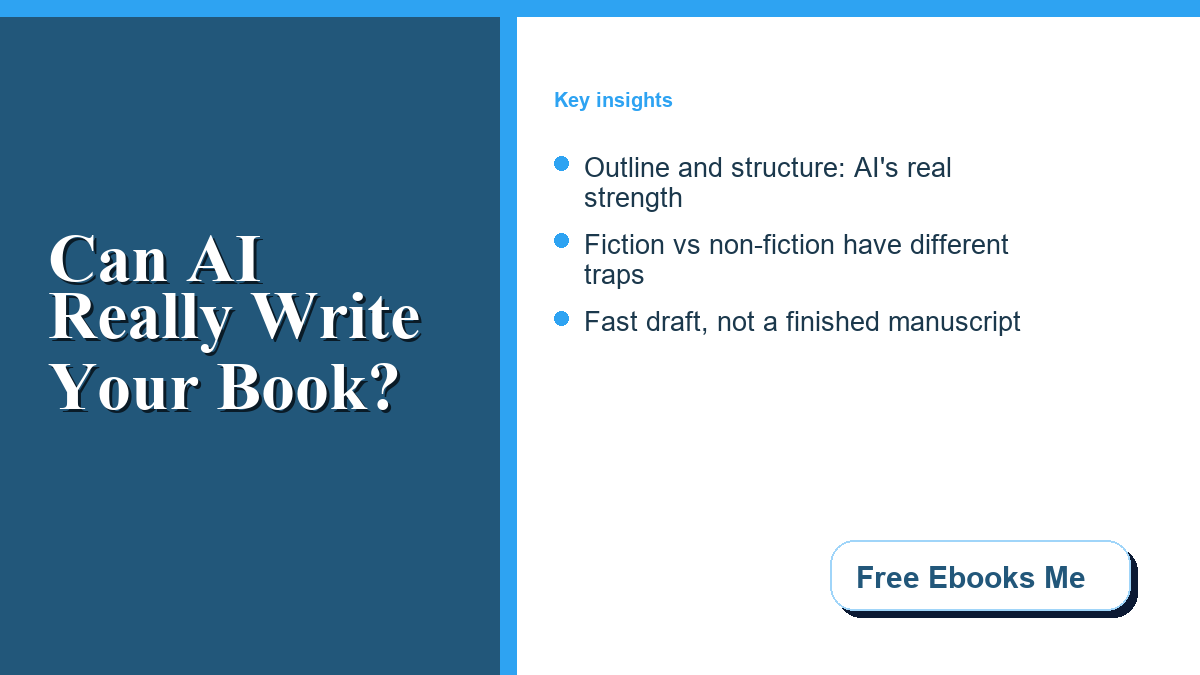
Every self-published author eventually hears the same claim: AI can write your book for you, start to finish, in under an hour. The honest version is more useful than the hype — AI genuinely compresses the drafting stage dramatically, but the books that end up worth reading still need a human doing the parts AI can’t: deciding what the book is actually about, and making the final judgment calls on voice and structure.
What AI Actually Speeds Up
The slowest part of writing a full-length book was never typing — it was the blank-page problem: outlining a structure that holds together for 200 pages, keeping character or argument threads consistent across dozens of chapters, and not losing momentum somewhere around chapter twelve. AI tools built for long-form writing handle exactly that scaffolding: a full outline generated from a premise, chapter drafts that stay consistent with what came before because the tool tracks the whole manuscript’s context rather than writing each chapter in isolation.
Fiction vs. Non-Fiction: Different Bottlenecks
For fiction, the hard part AI still can’t fully solve is a consistent character voice and a plot that earns its ending rather than resolving conveniently — a writer who reviews and adjusts chapter by chapter gets a far better result than one who accepts the first full draft. For non-fiction, the bottleneck looks different: research accuracy and citation matter more than voice, and a writer using AI for a non-fiction book should treat every factual claim as something to verify, not something to trust because it reads confidently.
What a Full AI Book Workflow Actually Looks Like
- Outline first, draft second. A full-manuscript outline reviewed and adjusted before any chapter gets drafted saves far more revision time than fixing structure after the fact.
- Draft in order, review in order. Reading and adjusting a chapter before moving to the next one keeps continuity errors from compounding across the manuscript.
- Export matters. A workflow that ends in EPUB, PDF, or Word — ready for a self-publishing platform or a traditional submission — saves a real formatting step most writers underestimate until they hit it.
Charigent’s AI book generator is built around that full outline-to-export workflow specifically, rather than a single-prompt “write me a book” gimmick that falls apart past the first few pages.
The Realistic Expectation
“Full book in under an hour” describes a first complete draft, not a finished, publication-ready manuscript — and that distinction matters more than the marketing headline suggests. What AI actually delivers is a complete structural draft in a fraction of the time a blank page would take, which still needs a real editing pass before it’s ready for readers. For anyone who has stalled on a book for months because starting felt harder than finishing, that’s still a genuine unlock — just not a replacement for editorial judgment on the way out.
 Free 30 Day Amazon Prime Trial!
 Free Kindle Cloud Reader App By Amazon
 30 Day Free Trial of Kindle Unlimited By Amazon!
0 Comments