

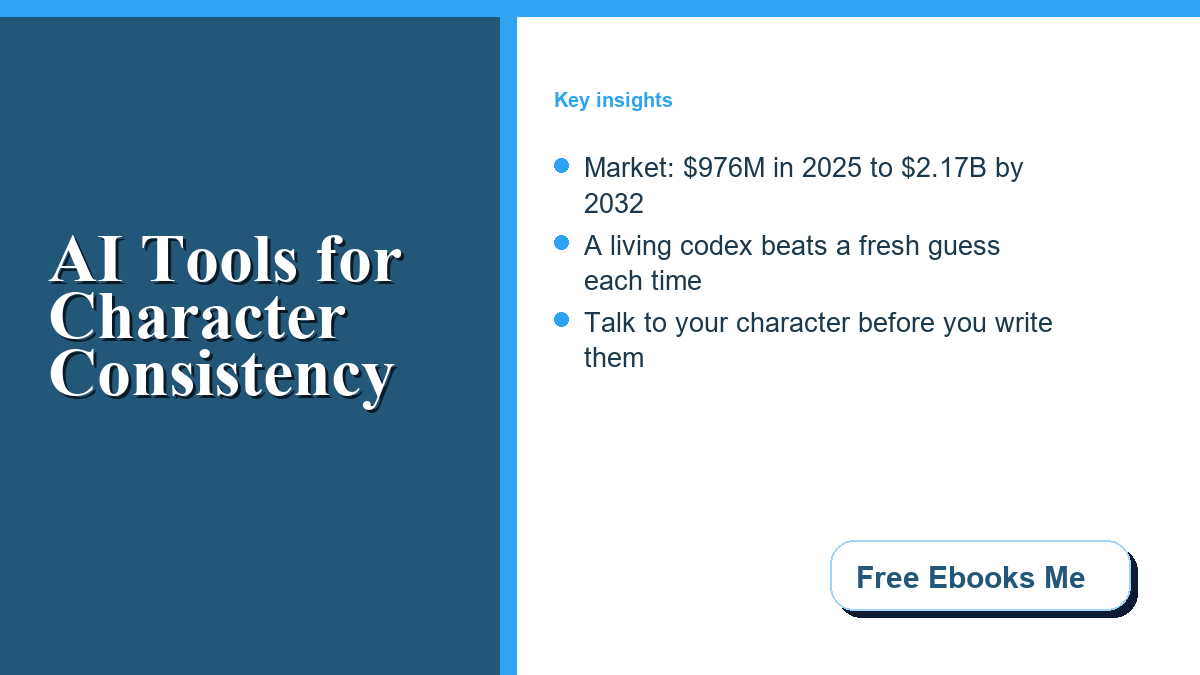
The hardest part of writing fiction has never really been the prose — it’s keeping a character consistent across three hundred pages, remembering what they know at chapter four versus what they only learn in chapter twelve, and catching the moment a personality quietly drifts because the writer forgot a detail established two hundred pages earlier. AI character tools built for fiction are increasingly aimed at exactly that problem.
Why Consistency Is the Real Bottleneck
Tools built around a persistent reference — a living codex or story bible where a writer defines a character’s facts, voice, and world details once — solve a different problem than a general-purpose chatbot does. A writer typing “write my character’s dialogue” into a plain AI assistant gets prose back with no memory of what that character said three chapters ago; a tool built around a maintained character reference catches the contradiction before it ships.
What This Actually Looks Like in Practice
- A defined personality that persists. Voice, motivations, and speech patterns stay consistent because the tool references the same character definition every time, not a fresh guess each session.
- Facts that don’t get forgotten. What a character knows, when they learned it, and who they’ve met stays tracked across the length of a manuscript instead of relying on a writer’s memory alone.
- A place to actually test the character. Some writers now draft dialogue by having a conversation directly with an AI version of their own character, catching a voice that doesn’t sound right before it goes into a scene rather than after a full chapter is written.
The Market Reflects Real Demand, Not a Gimmick
The AI character generator market was valued at roughly $976 million in 2025 and is projected to reach $2.17 billion by 2032 — growth driven by writers and studios treating character consistency as a real production problem worth paying to solve, not a novelty feature bolted onto a general writing tool.
Testing a Character Before It’s on the Page
One approach gaining traction among fiction writers is building the character as an actual interactive persona first — something with a memory of its own established facts and personality — and having a real conversation with it to see whether the voice holds up before committing it to a scene. Charigent’s character chat with editable memory works this way: a writer can build a character, give it the facts and backstory that define it, and talk to it directly to hear whether the voice actually sounds like the character before writing them into a real chapter.
Where This Fits in a Writing Process
None of this replaces the actual writing — it’s a consistency and development tool, not a ghostwriter. Used well, it catches the kind of character drift that normally only shows up in a beta reader’s notes, months after the manuscript is finished and much harder to fix than it would have been at chapter four.
 Free 30 Day Amazon Prime Trial!
 Free Kindle Cloud Reader App By Amazon
 30 Day Free Trial of Kindle Unlimited By Amazon!
0 Comments